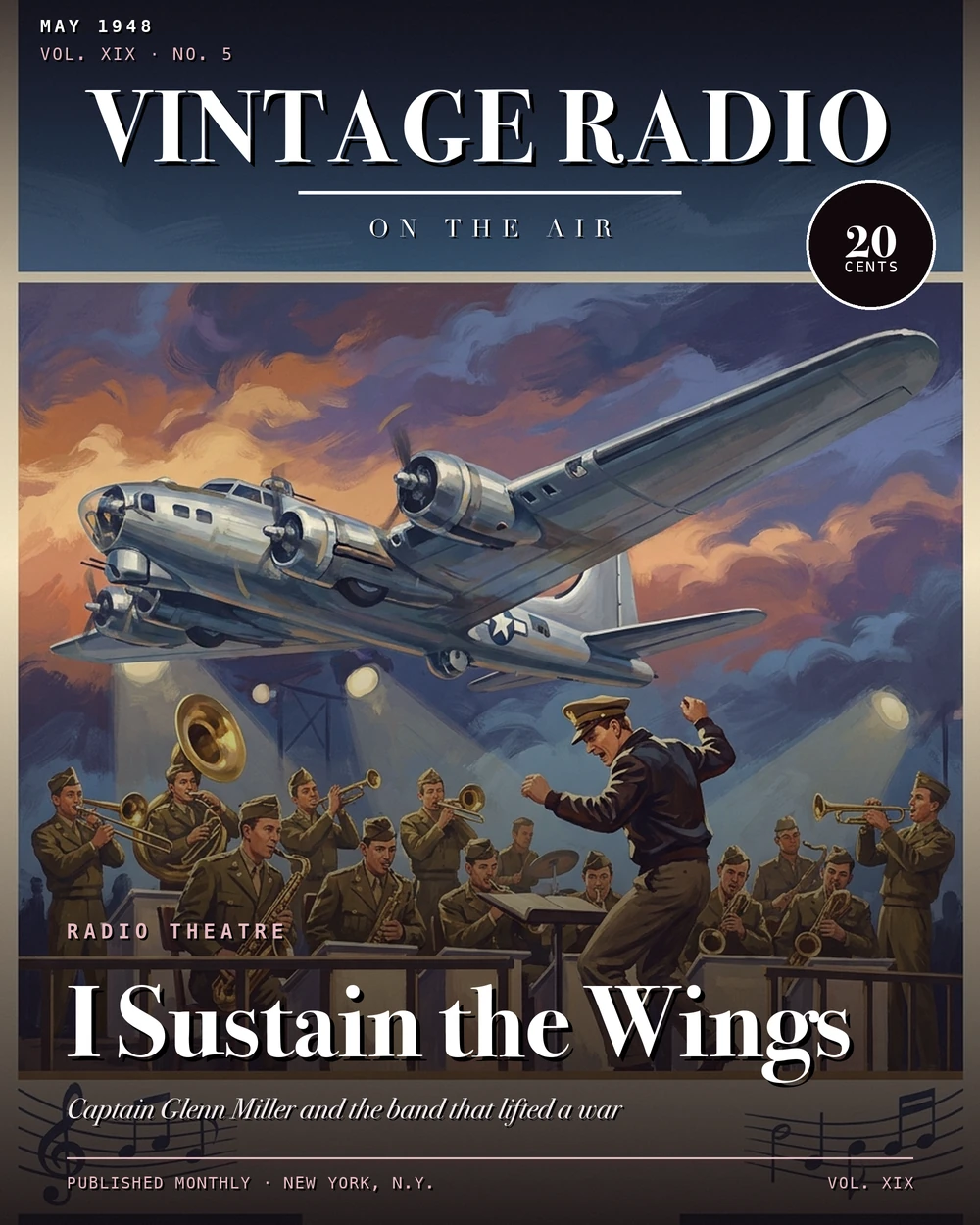
I Sustain the Wings
The Show Behind the Motto
The title comes from the Latin — Sustineo Alas, the motto of the U.S. Army Air Forces Technical Training Command, translated as "I Sustain the Wings" or "Keep 'Em Flying." That wasn't an accident. This was a military operation dressed in music, a weekly broadcast produced by the Army Air Forces Training Command Band under the direction of Captain Glenn Miller, with the explicit purpose of recruiting new airmen while simultaneously serving as a morale boost for troops already in uniform. It wasn't a civilian variety show with a patriotic theme; it was an official instrument of the war effort that happened to be very good radio.
The show began on CBS in June 1943, with some early broadcasts originating from Yale University's Woolsey Hall in New Haven, Connecticut, where Miller was stationed at the AAF Training School. By September 18, 1943, it had moved to NBC, where it aired on Saturday evenings — documented time slots include 6:00 to 6:30 p.m. and 11:30 p.m. to midnight — originating from the Vanderbilt Theatre in New York City. It ran on NBC weekly through June 10, 1944, and continued on air after Miller's departure until November 17, 1945.
Glenn Miller in Uniform
Miller had walked away from one of the most successful civilian big bands in the country to join the Army Air Forces, and he brought that same drive to his military role. The band he built for I Sustain the Wings was notably larger than anything he had led as a civilian — eventually reaching roughly 50 or more members, including a 20-piece string section alongside the usual brass, reeds, and vocalists. That scale let the orchestra move between swing, jazz, popular songs, and classical-inflected material without sounding stretched, which was precisely Miller's intention. He had deliberately recruited musicians from both popular and classical backgrounds as part of his vision for what AAF musical programming could be.
The show's theme music was itself a collaborative product of the military enterprise. "I Sustain the Wings" was co-written by Miller, pianist John Chalmers "Chummy" MacGregor, Private Sol Meyer, and Master Sergeant Norman Leyden, and was copyrighted on February 11, 1943. The program was also built around a consistent roster of performers rather than a rotating parade of civilian guests: vocalist Johnny Desmond, drummer and vocalist Ray McKinley, arranger and conductor Jerry Gray, and the vocal group the Crew Chiefs — whose members included Artie Malvin, Steve Steck, Gene Steck, Lynn Allison, and Murray Kane.
What the Program Was Trying to Do
The recruiting function was front and center. The broadcasts featured music alongside sketches detailing Army Air Forces units and specific job specialties, with the clear goal of making those jobs sound appealing to young civilian listeners. A 1948 history of wartime radio by Edward M. Kirby and Jack W. Harris described Miller's Army Air Forces band as a network favorite and noted that the program reached millions of teenagers — precisely the pool from which air cadets would be drawn.
At the same time, the show operated as public relations in the broader sense. General James H. Doolittle, Commanding General of the U.S. 8th Army Air Force, praised the program as a major morale-builder for troops in the European Theater of Operations, saying it was "next to a letter from home" in importance. That dual function — recruitment tool for the home front, entertainment for those already deployed — gave the show a reach and a purpose that went beyond ordinary music programming.
Miller and the band also recorded Uncle Sam Presents programs for the Office of War Information during the same period, working out of CBS Radio Theatre No. 4 during the CBS run and from the NBC Vanderbilt Theater afterward. Those recordings extended the band's presence to international audiences, layering yet another function onto what the ensemble was producing each week.
After Miller Left
On June 14, 1944, Glenn Miller departed for England with part of the band to perform for Allied forces in the European Theater. The stateside broadcasts continued. Harry Bluestone took over as conductor of the remaining ensemble, and both Bluestone and Felix Slatkin led AAF orchestras that filled the U.S. broadcast slot through the rest of the war.
Then, on December 15, 1944, Miller's military transport plane vanished over the English Channel while he was traveling to Paris to make advance arrangements for the band's concert tour. He was never found. The band — those in England and those back home — kept broadcasting and performing. The program ran on until November 17, 1945, when the final broadcast took place at Bolling Field Air Force Base in Washington, D.C. That last performance was also the final public appearance of the original Army Air Forces Band as a unit.
The episode titles that survive in the catalog give a sense of the program's musical range: "American Patrol," "Caribbean Clipper," "Flyin' Home," "Everybody Loves My Baby," "It Must Be Jelly, Cause Jam Don't Shake Like That," and "Welcome Home Broadcast" — that last title carrying an obvious weight given when the show was winding down.
What Survived
Ten episodes are known in the catalog, with the earliest surviving recording dated to October 16, 1943 — that date reflects the oldest episode in the collection rather than the actual premiere, which preceded it by several months. Enough material survived that RCA released a 5-LP set in 1956 drawing on the broadcasts, and BMG later reissued that material as a 4-CD set in 2001. An album titled I Sustain the Wings Broadcasts, 1943–1944 came out that same year, giving the program a commercial afterlife that most wartime radio never received.
That the recordings exist at all is partly a function of the show's official status — a government-produced program with reasons to document its own output. What those recordings capture is something that doesn't map neatly onto either "military broadcast" or "music program": a large, skilled orchestra playing real arrangements across a genuinely wide range of styles, in service of a cause that was very much the subject of the music itself.